|
Grand Designs- Amateur Photographer
One of the main differences between an amateur photographer and someone working as a professional, is that the professional usually has a set brief from the client about what type of photograph they require. Although the pro is then free to let their photography skills give the client that unique picture, that made him or her worth hiring, they are still working on a specific project. For the amateur, things are little different. They are free to photograph whatever they want, but this can often be a hindrance, rather than an advantage. Having no goal or specific subject to work on, they could be wondering just what to shoot, so with this in mind, it’s good to set yourself a project. The main advantage of this is that it gives you a certain amount of tunnel vision, which in this case is a good thing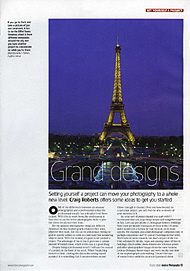 . .
Despite being professional myself, I still use this as the basis of my work, which is mainly on spec to a client. I come up with an idea and present it in a way that I know my client (usually a magazine) will like it. So creating the idea, is like setting myself a project, one that I can concentrate on and follow through to the end. Once you are concentrating on a particular project then although you may miss other shots whilst out in the field, you are at least fully concentrating on the one in hand, and so you will be able to give it your 100% attention. Concurrently, this will mean you spot things that might otherwise have gone unnoticed, which more than makes up for missing the other subjects.
So what sort of project can you begin with? Well, for starters keep things simple and straightforward. Lets say you decide to photograph historic buildings. Now there are literally thousands of them in the UK alone and would cost a fortune to cover them all. So try cutting this down to be more specific and cover cathedrals only, or better still, old buildings in your area or perhaps only 17th century buildings in your area. If this is your brief, then you are therefore going to have do some research, but that’s half the fun and you’ll then begin to get an idea about them. Check their websites for details, maps and opening times. Look at the online photo libraries for reference shots that other photographers have done of each location. Then get some Ordnance Survey maps and see if you can work out the best time of day to shoot each building. This type of research was useful to me recently, for an article I am writing about the castles in south east England and I’ve been able to plan a careful timetable to shoot six different castles over two days, all in their best light.
Keeping on a buildings theme, how about photographing modern architecture as well. You could choose a new office block in your area and try shooting it from all angles. Because buildings can look so different in varying lighting conditions, you could shoot it at different times of the day. Or how about shooting floodlit buildings only, which would test your research knowledge, as well as your metering skills, as night shots can be tricky to expose correctly.
On the subject of locality, how about doing a project on your home town and not just the buildings either. You could include the people, the parks and even the urban wildlife and fauna. I bet you’ll find things to photograph that you never knew were there in the first place.
Another great subject are bridges. Built in all shapes and sizes, there are some very bland ones, but there are also many that can be described as architectural masterpieces. The engineering that goes into designing and building them is astounding, so find a good one and shoot it from all angles. You could shoot it close up, from afar, in the morning, late afternoon and then at night. By concentrating your time on this one subject, you’ll come back with some very interesting and varied shots.
I recently spent a few days in Paris and of course the main symbol of Paris is the Eiffel Tower. So part of my assignment whilst in the capital, was to photograph the tower not only close up, but from anywhere else in the city where it kept coming into view. This mini-project gave me a great collection of pictures, with some very different views.
What about setting a project for landscape photography? Well, instead of shooting wide views, why not try concentrating only on details within the landscape itself. This could be as simple as isolating a solitary tree or the rippled sand on a beach or the lichen on the surface of a rock. With a telephoto lens you can effectively isolate these details from their surroundings and even get some creative abstracts. There’s so much to spot, but because you are have your eye set on these details, you’ll again find that you notice so much more than if shooting a wide scene. In town, you could concentrate on a sequence of numbers one to ten and shoot any subject featuring a number, such as billboards, or shop windows to get a sequence. It can be fun trying to find new and original ones to look different from the last.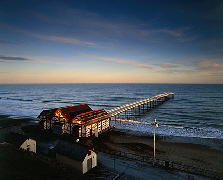
Another feature in a landscape you could focus on is water. This element can be conjured up in waterfalls, the sea, rivers and ponds. Set yourself a project of only shooting a scene with water in the composition. If you have a favourite stretch of river near your home, use this as your project and shoot it along its course photographing the views, the wildlife it attracts as well as the water itself and the way it moves and reflects the light. Water doesn’t only have to be in the countryside of course, in town you could include fountains or even neon signs reflected in puddles that the rain has left behind. A series of pictures featuring reflections in water would be another great project to tackle.
For some real photographic therapy to test your discipline, how about arming yourself with a camera and only one lens. Take your favourite wide angle and only shoot subjects with this combination. It’s probably more difficult than you think especially if you are used to taking a whole arsenal of lenses on each trip, but I guarantee you will feel rewarded when you see your results. The 50mm is an ideal lens for this project, as it is the nearest to our field of vision and such a versatile lens that a whole variety of subjects can be successfully taken with it.
Although I shoot colour for 90% of my photography, I do occasionally shoot the odd roll of black and white, usually in the form of Agfa’s Scala transparency film, which I love for its convenience. However, a film that I haven’t yet tried, but keep promising myself to, is black and white infrared. The results from this type of film can be amazing, but I think you would need to give it your full attention to get the best out of it, so I plan to set a few days and locations aside and go out armed only with this film and test its full potential.
Something else that I would like to explore more is the panoramic format. I use a Mamiya RZ for most of my photography, which when cropped gives the same aspect and size of film as the Hasselblad Xpan camera that I know so many people love. I therefore often crop to this format if the subject suits, but I have never gone out specifically with the intention of shooting this elongated format. I especially like the vertical panoramic shots that you can take with this format and so this is another project I personally plan to try. If you shoot 35mm or even digital then you can easily crop these down as well, either in a transparency mounts or when printing, and although the size will be a lot smaller, the affect is the same.
With the changing seasons you could set yourself the task of photographing a single tree taken at key times throughout the year, showing the seasonal transitions. If you enjoy photographing flowers, create a series of shots of only parts of the flower in abstract form. The sky is a good subject, as it offers a wide and varied assortment of colours and cloud formations, so set yourself the task of capturing it in as many different conditions as possible.
These are just a few examples you could work on, so next time you have the urge to shoot some film but are stuck for new ideas of what to photograph, then set yourself a project to get your brain buzzing and let your imagination be the key to a whole new set of pictures.
© Craig Roberts
|


